
Frobenius’ Beast Bait
(MathPickle, 2025)
To introduce Beast Bait, get students to choose a target creature number between 5 and 25. Let’s say the target number is 9.
It is then a classroom competition to find a set of integers that can be added together in any combination to hit all numbers bigger than 9, but to let 9 escape.
Example: Does (3,5) work? No – because 3+3+3 = 9! What about (4,7,10)? Does that work? We can’t get 9. That’s good. We can get 10, and 4+7 = 11, and 4+4+4 = 12, but sadly, there is a problem at 13. There is no way to get to it. One solution is (2,11). That gets all numbers greater than 9, but not 9 itself. Yippee!
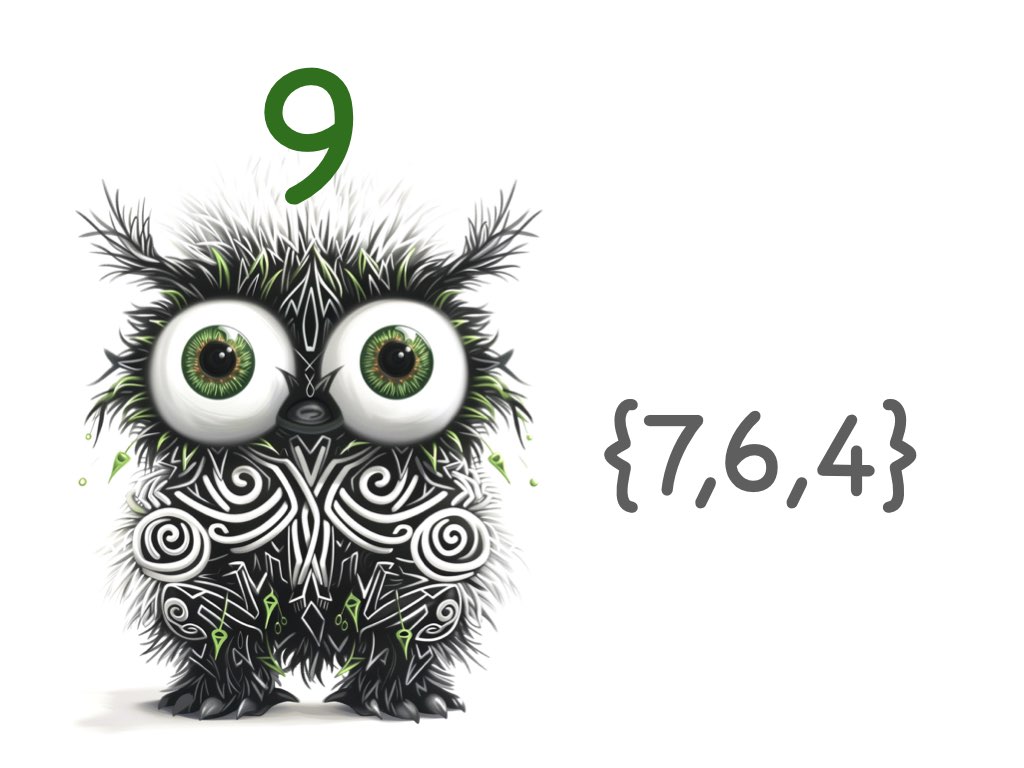
However, there is another rule. We score each solution by taking its largest number, so (2,11) scores 11. High scores are bad. There is another solution that scores 7. Can you find it? You guessed it… just look at the picture above. 😉
The sequence of best scores can be found on the online encyclopedia of integer sequences: OEIS: A386243.
The lowest-scoring sets are as follows:
Hitting all integers greater than 5, the best set is (3,4)
Hitting all integers greater than 6, the best set is (4,5,7)
Hitting all integers greater than 7, the best set is (3,5)
Hitting all integers greater than 8, the best set is (5,6,7,9)
Hitting all integers greater than 9, the best set is (4,6,7)
Hitting all integers greater than 10, the best set is (4,7,9)
Hitting all integers greater than 11, the best set is (4,5)
Hitting all integers greater than 12, the best set is (5,8,9)
Hitting all integers greater than 13, the best set is (3,8)
Hitting all integers greater than 14, the best set is (6,9,10,11)
Hitting all integers greater than 15, the best set is (6,7,10)
Hitting all integers greater than 16, the best set is (5,7,13)
These are not easy to find! Students should not be expected to find the best sequence. They just need to find a sequence which scores better than all the kids in the other classroom. 😉
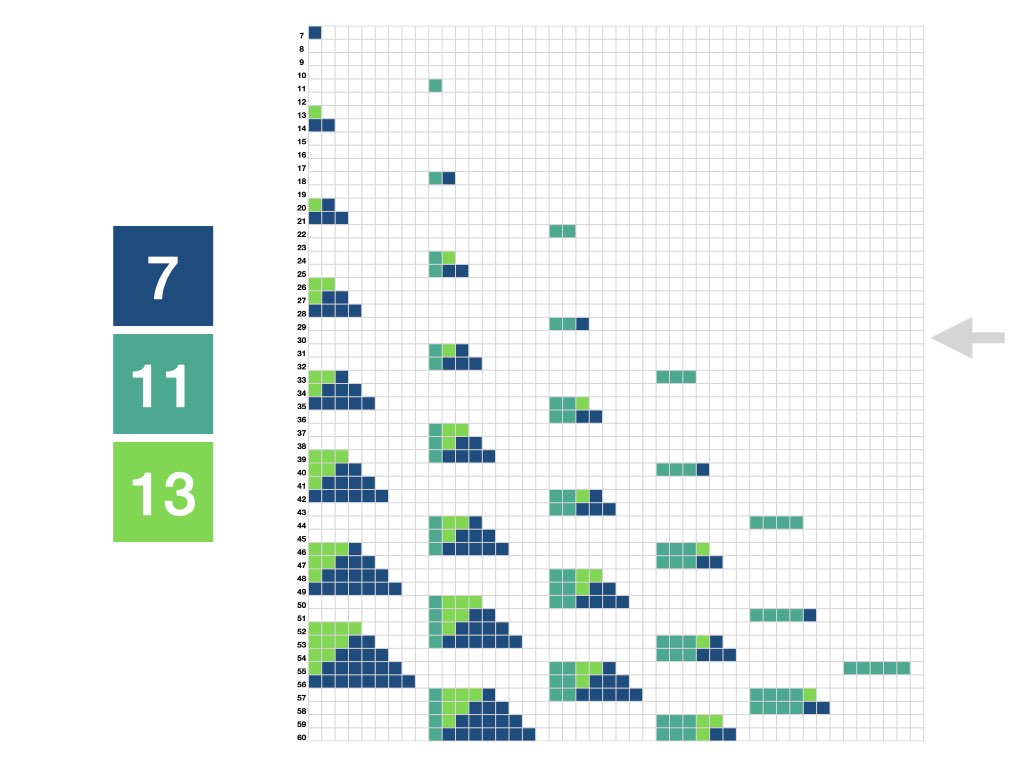
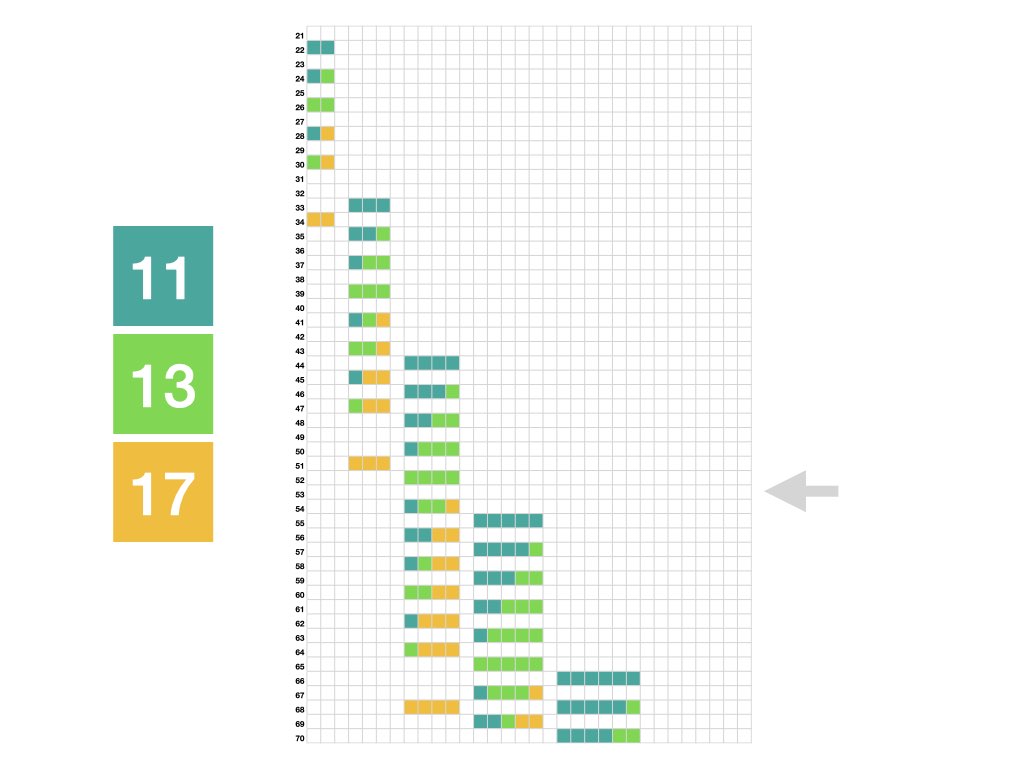
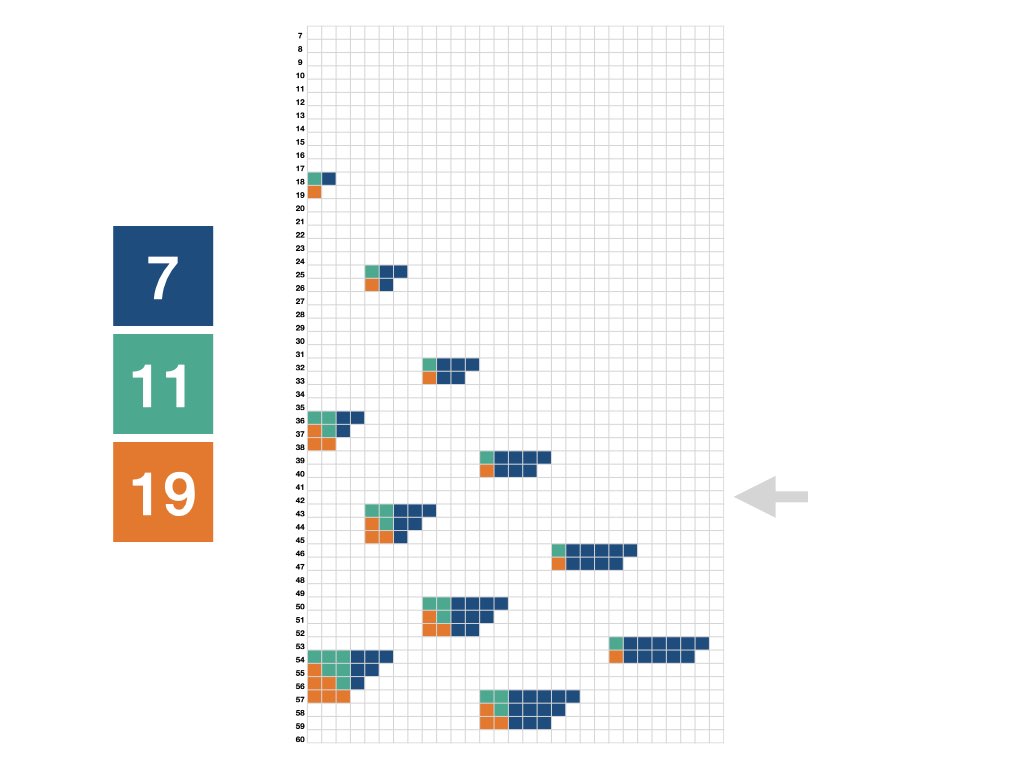
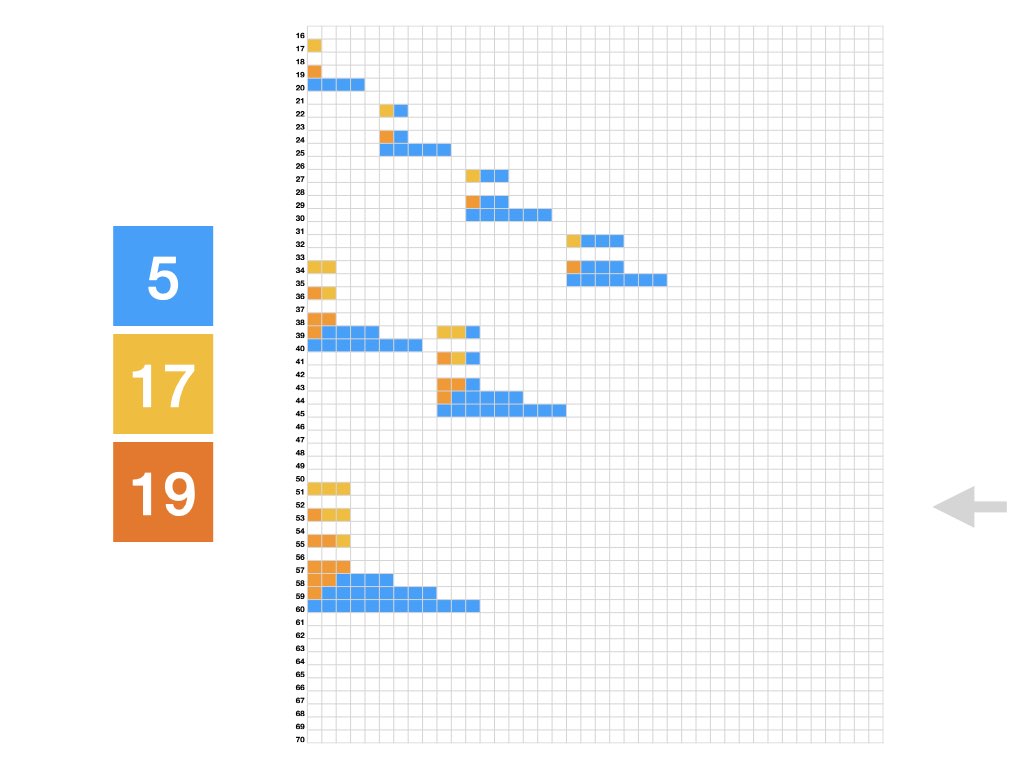
A lot of pretty patterns emerge when you choose any set of numbers and start looking for the smallest number that cannot be expressed as a sum. Above we can see that there is no way to reach 30 with {7,11,13}.
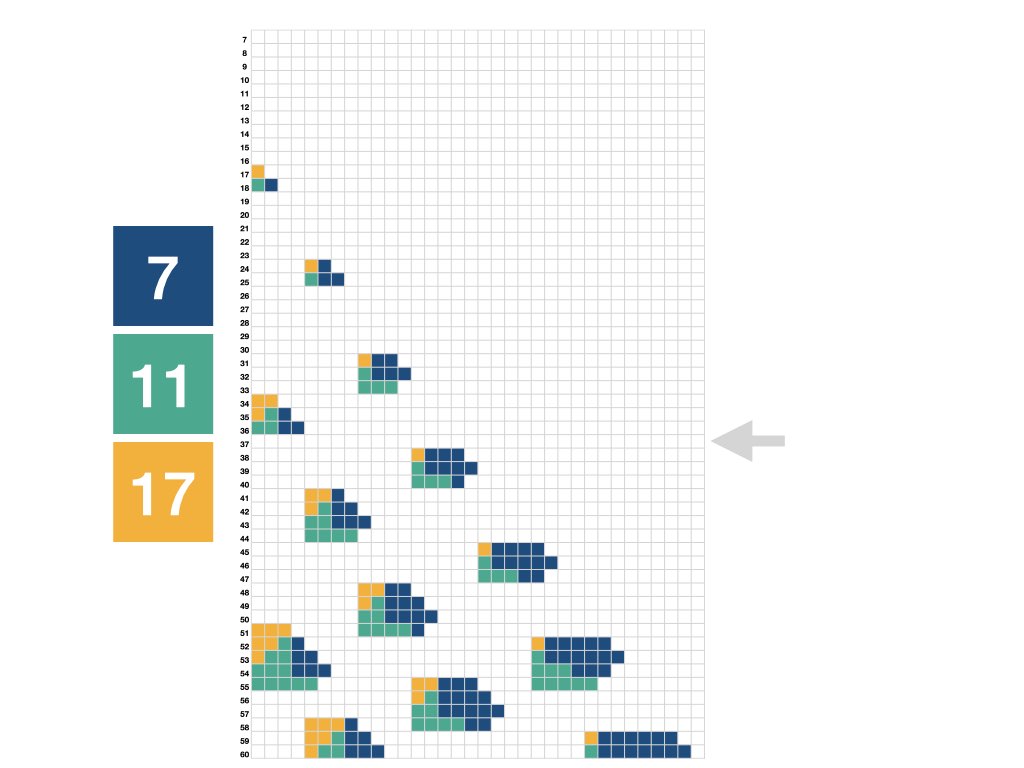
There is no way to reach 37 with {7,11,17}.
Teaching is an experimental science. Don’t expect to be a great teacher your first year standing in front of a class.
Standards for Mathematical Practice
MathPickle puzzle and game designs engage a wide spectrum of student abilities while targeting the following Standards for Mathematical Practice:
MP1 Toughen up!
Students develop grit and resiliency in the face of nasty, thorny problems. It is the most sought after skill for our students.
MP2 Think abstractly!
Students take problems and reformat them mathematically. This is helpful because mathematics lets them use powerful operations like addition.
MP3 Work together!
Students discuss their strategies to collaboratively solve a problem and identify missteps in a failed solution. Try pairing up elementary students and getting older students to work in threes.
MP4 Model reality!
Students create a model that mimics the real world. Discoveries made by manipulating the model often hint at something in the real world.
MP5 Use the right tools!
Students should use the right tools: 0-99 wall charts, graph paper, mathigon.org. etc.
MP6 Be precise!
Students learn to communicate using precise terminology. Students should not only use the precise terms of others but invent and rigorously define their own terms.
MP7 Be observant!
Students learn to identify patterns. This is one of the things that the human brain does very well. We sometimes even identify patterns that don't really exist! 😉
MP8 Be lazy!?!
Students learn to seek for shortcuts. Why would you want to add the numbers one through a hundred if you can find an easier way to do it?

Please use MathPickle in your classrooms. If you have improvements to make, please contact me. I'll give you credit and kudos 😉 For a free poster of MathPickle's ideas on elementary math education go here.
Gordon Hamilton
(MMath, PhD)
