
Crumbling Castles
(MathPickle, 2025)
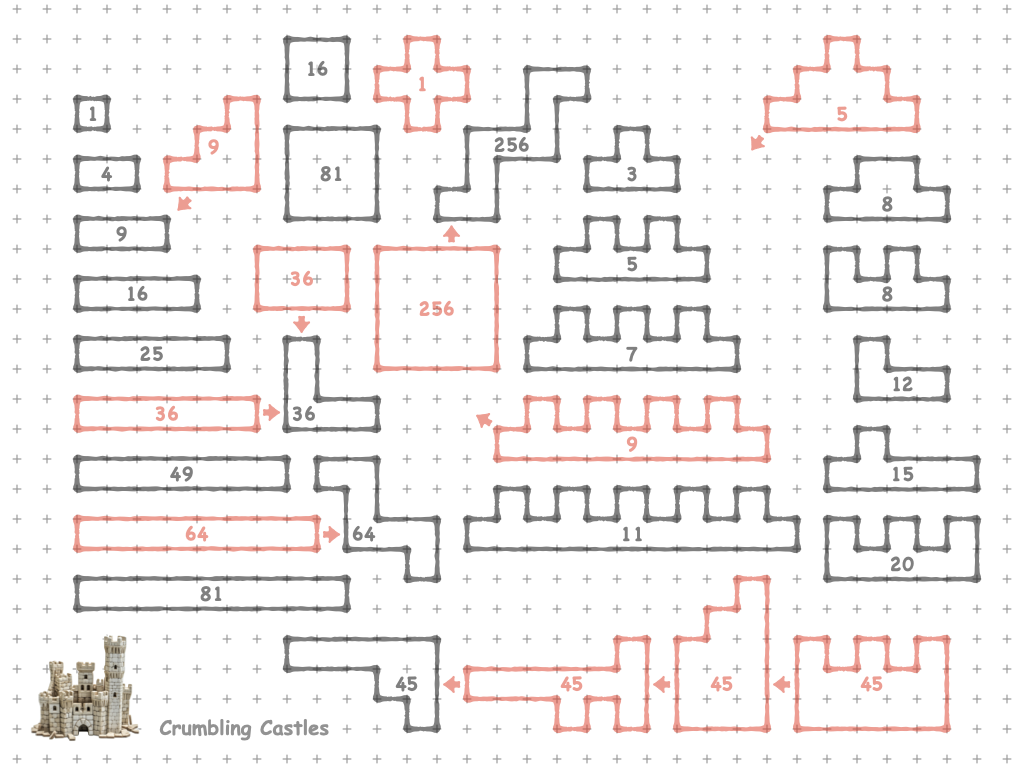
Ready for some inductive problem solving? You can first try to figure out what’s going on yourself… Here is the puzzlesheet. Spend 5 minutes looking for aptterns and then read on so you’ll see how to present it to your students.
Spoiler alert!
A good hint is to look at the shapes’ perimeters. Any observations? Notice the red staircase that scores “9” near the top. It scores 9 because the perimeter is made up of length three and length one edges: 9=3*3*1*1*1*1*1*1.
So the score of a shape equals the product of the edge lengths. Why are some shapes black and some red? Spoiler alert! The red shapes are inefficient. You don’t need an area-6 shape to produce a score of 9. You can achieve a score of 9 with an area-3 shape.
Pedagogy. How to present “Crumbling Castles” to your class.
Ask students to contribute shapes. You might do that by handing out squares or just getting them to describe the shape.
Calculate the product of the edges and score it for the students. If you know the area is not the smallest possible to produce that score, draw it in red immediately and pretend to be upset with the student for submitting such a horrible shape. We don’t like red shapes! Use emotional language! That engages students.
If you are not sure if a shape is black or red, draw it black and praise the student for submitting such a wonderful shape. 😉 If another student later submits a shape that has a smaller area that gives the same score, go back and redraw the original shape red… and pretend to be upset with the student who submitted the original shape.
If a student asks you to score something too big – say, “a true mathematician looks for patterns with small examples. Patterns are often too difficult to see when you deal with big examples. It’s also difficult for me to calculate! Be kind!”
Did you notice any patterns? Do you have any hypotheses? When you present this to your students, you want to celebrate all of the hypotheses that students come up with – especially the bad ones! Here are two ideas from real classrooms:
- All positive odd numbers can be created using castle turrets. Here we see 3-5-7-9-11. Does this pattern continue? Yes.
- All shapes score equal to (number of squares) * (number of squares). That’s right for some of the shapes, but not all of them.
After 20-30 minutes of students presenting shapes, pass out or display the puzzlesheet above. Here is the pdf.
Let students continue to try to figure out the rules. Often, this will end with students not discovering the rules. That’s ok. It is good to have students flex their inductive problem-solving skills, regardless of whether they discover the rules.
Some follow-up exercises:
- Ask a student to give any score. Now it is a challenge for everyone to find a smallest shape for which this is the score. The score 45 was a lot of fun for me!
- There are some numbers that cannot be a score, like 2 and 10. That’s interesting! Instead of telling students the result. Ask them to create shapes that give answers of 8-15. Giving impossible problems every so often is good pedagogy!
- Triangular grids are just as beautiful!
Teaching is an experimental science. Don’t expect to be a great teacher your first year standing in front of a class.
Standards for Mathematical Practice
MathPickle puzzle and game designs engage a wide spectrum of student abilities while targeting the following Standards for Mathematical Practice:
MP1 Toughen up!
Students develop grit and resiliency in the face of nasty, thorny problems. It is the most sought after skill for our students.
MP2 Think abstractly!
Students take problems and reformat them mathematically. This is helpful because mathematics lets them use powerful operations like addition.
MP3 Work together!
Students discuss their strategies to collaboratively solve a problem and identify missteps in a failed solution. Try pairing up elementary students and getting older students to work in threes.
MP4 Model reality!
Students create a model that mimics the real world. Discoveries made by manipulating the model often hint at something in the real world.
MP5 Use the right tools!
Students should use the right tools: 0-99 wall charts, graph paper, mathigon.org. etc.
MP6 Be precise!
Students learn to communicate using precise terminology. Students should not only use the precise terms of others but invent and rigorously define their own terms.
MP7 Be observant!
Students learn to identify patterns. This is one of the things that the human brain does very well. We sometimes even identify patterns that don't really exist! 😉
MP8 Be lazy!?!
Students learn to seek for shortcuts. Why would you want to add the numbers one through a hundred if you can find an easier way to do it?

Please use MathPickle in your classrooms. If you have improvements to make, please contact me. I'll give you credit and kudos 😉 For a free poster of MathPickle's ideas on elementary math education go here.
Gordon Hamilton
(MMath, PhD)
