
False Cnjecture
(MathPickle, 2026)
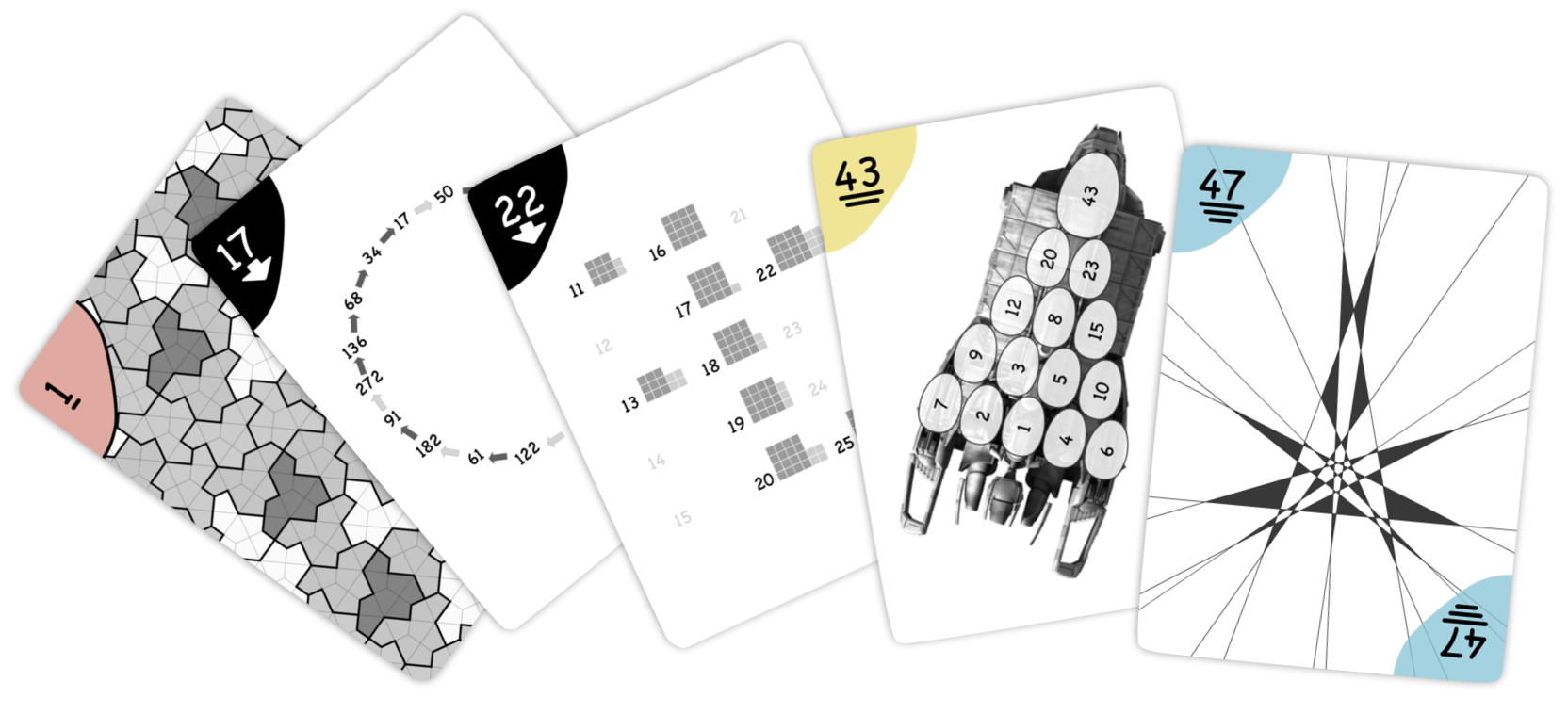
False Conjecture
(Rules)
The Deck
The cards are numbered 1-60 in four suits of fifteen cards each:
- 1-15 are red.
- 16-30 are black.
- 31-45 are yellow.
- 46-60 are blue.
Setup
- Choose a scoring card based on the number of players.
- Form teams as indicated on the scoring card.
- Members on the same team should sit next to each other, without looking at each other’s cards.
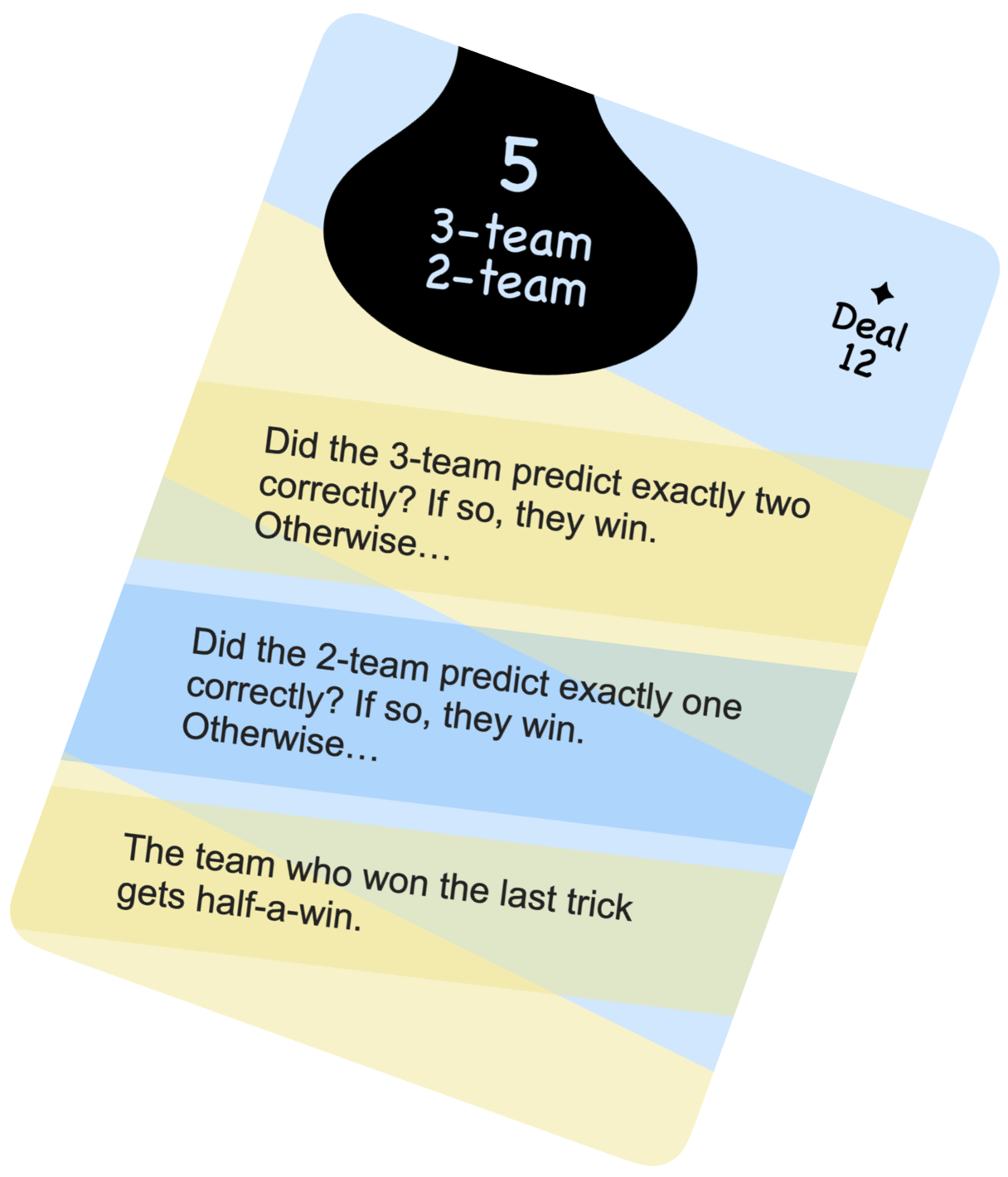
- Check the ‘Deal’ number on the scoring card.
- Deal this number of cards to each player.
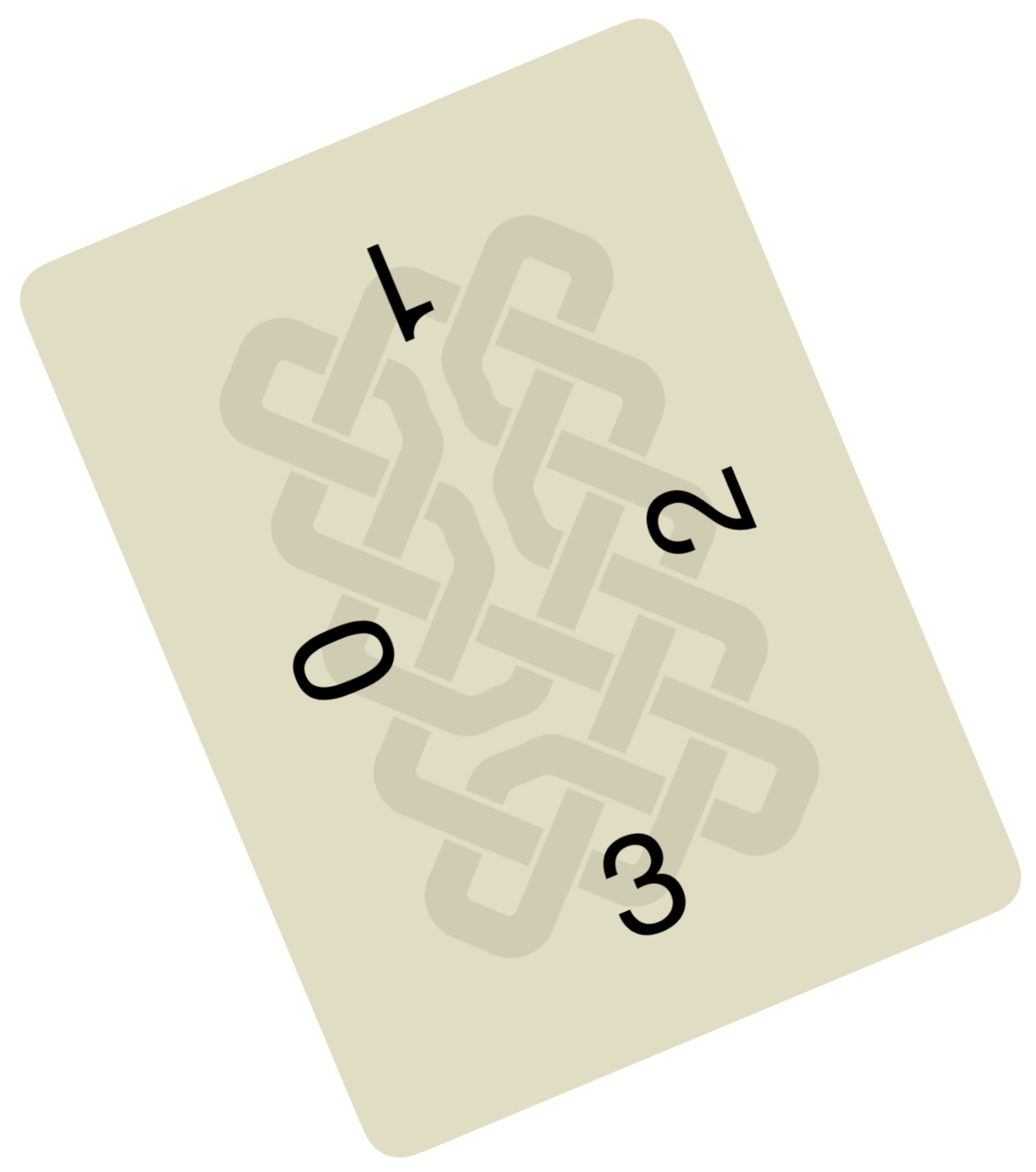
- Each player on a team takes a bidding card of the same colour.
- The cards have 0–3 on one side and 4–7 on the other.
Bidding
- Starting with the player to the left of the dealer and going clockwise, players use their bid card to reveal how many tricks they think they will win.
- The bid should face the centre of the table.
- If you’re unsure how to bid in your first games, bid the number of cards in your hand divided by the number of players. Round up if you’re an odd age. Round down if you’re an even age.
Passing Cards
- All players simultaneously show a card, announce its value and pass it to the player on their left who puts it in their hand.
- The player who was passed the lowest card leads the first trick.
Trick
- The lead player plays a card face up in front of them.
- Going clockwise around the table, everyone else plays one card face up.
Following the Lead
- If possible, players must play a card of the same colour (red, black, yellow, or blue) as the lead card. Otherwise, they may play any card.
Winning a Trick
- Normally, the highest card wins the trick.
- However, if a black card is played by anyone, the lowest card wins the trick.
- The winner collects all the cards from the trick and places them face down in a stack, partially overlapping any previously won stack.
- The winner then leads the next trick.
Winning a Game
- After all cards have been played, answer the questions on the scoring card to determine which team wins the game.
- Play games until one team gets two wins.
False Conjecture
(Description of Art)
Let’s link each piece of math-art to its card number. This will be completed by October.
1. The Hat Monotile
The “hat” monotile can tile the plane, but only aperiodically. This means it lacks translational symmetry—you cannot shift the overall pattern in any direction and have it perfectly overlap its original footprint.
2. The Binary Tree
This tree branches in two, 10 times in total. If you look closely with a magnifying glass, you’ll find exactly 1024 little buds on the ends.
3. The Bent Polyomino
The L-tromino (a bent shape made of 3 squares) is the smallest polyomino capable of forming an irreducible rectangle. Specifically, it can tile a 5×9 rectangle in such a way that the overall shape cannot be subdivided into any smaller rectangles made of those same tiles.
4. The Four-Color Theorem
The map of Ukraine can be colored using just four colors so that no two regions sharing a border share the same color. Thanks to the Four-Color Theorem, this is true for all 2D maps, not just Ukraine.
5. The 5-Question Venn Diagram
The 5-question Venn diagram records dice rolls that answer five questions:
- Do some of the dice add to 7?
- Do some of the dice add to 8?
- Do some of the dice add to 9?
- Do some of the dice add to 10?
- Are all the dice different?
One of the regions in this Venn diagram is impossible to fill with a dice roll.
6. Picasso’s Canvas
Picasso’s Canvas: An acceptable paint stroke never completely covers a 2×2 square. Also, the last number visited must be the product of the first number and the total number of squares in the paint stroke. This specific path leaves only 6 unpainted squares, the lowest yet discovered for an 8×8 grid.
7. Mondrian Art Puzzle
Mondrian Art Puzzle: An acceptable canvas is covered by rectangles, no two of which share the exact same dimensions. The score is the difference in area between the largest and smallest rectangles. This solution scores 7, the minimum possible for a 12×12 grid. It remains an open problem whether any sufficiently large square can score a perfect zero.
8. Archimedean Tilings
There are exactly 8 semi-regular (or Archimedean) tessellations: repeating wallpaper patterns made of two or more types of regular polygons where every single vertex is identical.
9. Roll Reversal
This puzzle by Ali Muniz is called Roll Reversal. Start with a 2-7 column and try to make a 7-2 column in the fewest steps. Each step allows you to cut a rod into smaller integer lengths or glue two neighboring rods together. Duplicate lengths are not permitted in a column. Also, at no point can you exceed the length of your longest starting rod.
10. The Lazy Architect
The Lazy Architect: Build a mansion with one room of area 1, one room of area 2… all the way up to one room of area 10. Do this with the minimal number of walls. This particular solution uses 7 horizontal and 7 vertical walls (14 total), but 14 walls isn’t lazy enough. This is not the fewest number of walls possible for the 1–10 mansion.
11. The Fraction Loop
It takes exactly 62 steps to start at 1 and return to 1 using only two allowed operations: adding 1/11 or taking the reciprocal (flipping the fraction).
12. Hexiamonds and Pentominoes
There are exactly 12 ways to glue six equilateral triangles together edge-to-edge (forming shapes known as hexiamonds). Coincidentally, there are also exactly 12 ways to glue five squares together edge-to-edge (forming pentominoes).
13. The Archimedean Solids
There are exactly 13 Archimedean solids. These highly symmetric polyhedra are composed of regular polygons and are “vertex-transitive”—meaning the geometric arrangement of faces around every single vertex is identical.
14. Dissecting the Square
The fewest number of acute triangles needed to perfectly tile a square is 8. (Your original note was a fragment, so I completed the thought! Any dissection using 7 or fewer triangles inevitably forces at least one right or obtuse angle).
15. Banyan Root Puzzle
Banyan Root Puzzle: Starting at 1, add integers sequentially so that each new number is the sum of exactly two previous numbers on the path back to 1. You must always place the new integer in a way that minimizes its distance (steps) from 1 without reorganizing the previously built sequence. Under these strict rules, 15 is the first integer that can be reached at two different distances from 1.
Standards for Mathematical Practice
MathPickle puzzle and game designs engage a wide spectrum of student abilities while targeting the following Standards for Mathematical Practice:
MP1 Toughen up!
Students develop grit and resiliency in the face of nasty, thorny problems. It is the most sought after skill for our students.
MP2 Think abstractly!
Students take problems and reformat them mathematically. This is helpful because mathematics lets them use powerful operations like addition.
MP3 Work together!
Students discuss their strategies to collaboratively solve a problem and identify missteps in a failed solution. Try pairing up elementary students and getting older students to work in threes.
MP4 Model reality!
Students create a model that mimics the real world. Discoveries made by manipulating the model often hint at something in the real world.
MP5 Use the right tools!
Students should use the right tools: 0-99 wall charts, graph paper, mathigon.org. etc.
MP6 Be precise!
Students learn to communicate using precise terminology. Students should not only use the precise terms of others but invent and rigorously define their own terms.
MP7 Be observant!
Students learn to identify patterns. This is one of the things that the human brain does very well. We sometimes even identify patterns that don't really exist! 😉
MP8 Be lazy!?!
Students learn to seek for shortcuts. Why would you want to add the numbers one through a hundred if you can find an easier way to do it?

Please use MathPickle in your classrooms. If you have improvements to make, please contact me. I'll give you credit and kudos 😉 For a free poster of MathPickle's ideas on elementary math education go here.
Gordon Hamilton
(MMath, PhD)
